At this point in the year, we start thinking about winter—even though temperatures show no sign of dropping—but we still look forward to the period when bee families will...


At this point in the year, we start thinking about winter—even though temperatures show no sign of dropping—but we still look forward to the period when bee families will...
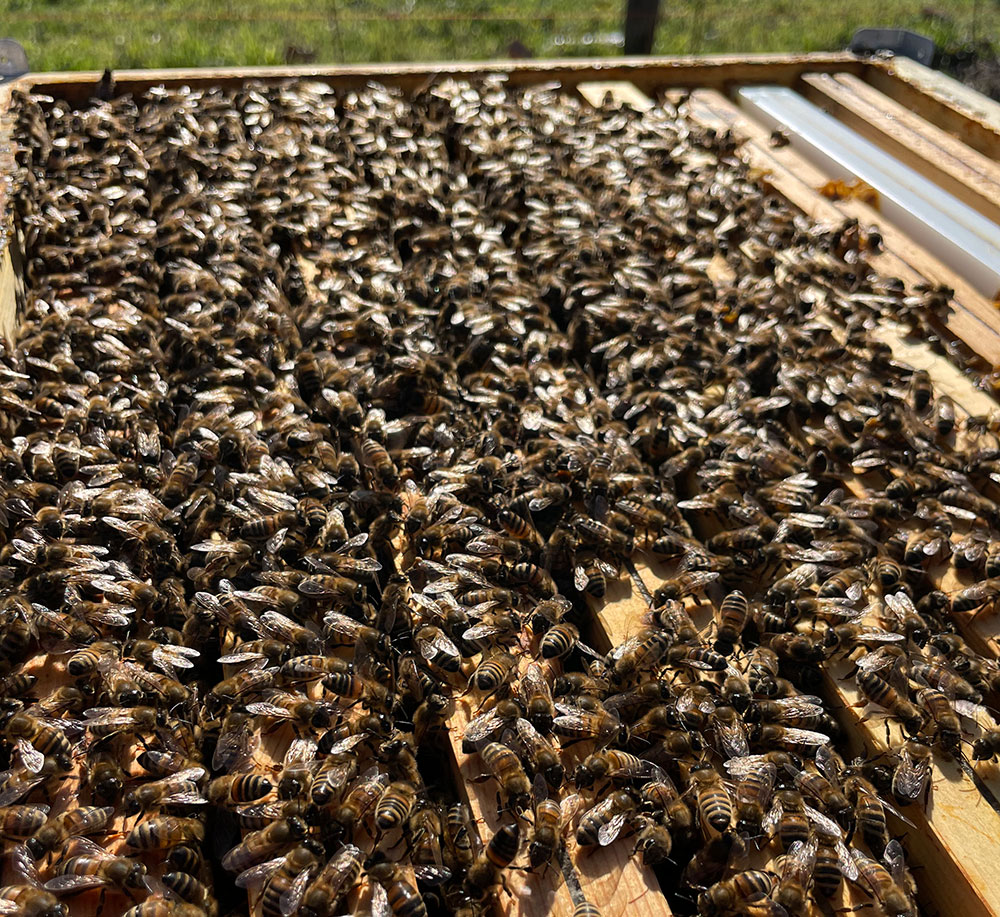
Let's start by saying that the hive is not exactly the home of bees, but something that we beekeepers have invented in order to establish a method known as “rational beekeeping,” in which bees are bred by providing them with large rectangular wax sheets on wooden frames, on which they build hexagonal cells where the queen lays her eggs. In nature, however, their “homes” are found in crevices or tree trunks, and the honeycombs they build have irregular patterns with wonderfully curved shapes.
Precisely because collecting honey from there did not allow their supply to remain intact, beehives were created, in which only the honey in the honey super (a kind of wooden frame with wooden frames inside that is placed on top of the hive during periods when bees import nectar and pollen) is extracted.
In February, temperatures in this part of Italy exceed 14 degrees during the warmest hours of the day, which is the threshold that allows bees to leave the hive. So we meet up with Claudio, a beekeeper with many years of experience and also my teacher, to see how things are going. How are the colonies doing? If the brood is uniform, it is a sign that the queen is doing well and has started laying eggs again after winter. If, on the other hand, it is mosaic-like—i.e., irregular in shape—then the hive needs to be fed and a frame from a strong colony needs to be inserted to give the colony some energy. Sometimes, two weak colonies can also be joined together.
The first sunshine of the year is a special moment. We remove the bottom of the hives to check for parasites, scrape them clean, and disinfect them with a blowtorch. And then comes the moment I've been waiting for for several months. Opening the hives and watching the bees intrigued me from the start, but I was a little afraid. Over time, that buzzing became a relaxing background noise, a sound to listen to carefully to understand the state of the colony, the music of a dance that I can't stop watching and in which everyone in the company knows what to do.
Just as we would with a living organism to see if it is healthy, we observe and listen, and we will continue to do so throughout the beautiful season. We look for the queen and observe whether the brood is uniform or irregular. We check whether the bees have their honey supplies, which are usually found on the side frames. If they do not, we intervene with supplementary feeding.